New-build housing market in Croatia: Growth in Zagreb and selective shifts along the coast
According to the latest report from the portal prodaja-nekretnina.com, the market for newly built apartments in Croatia over the past month (1.2.2026. - 1.3.2026) shows moderately divergent trends – strong growth in certain urban centers, while most coastal destinations are experiencing stagnation or slight corrections.
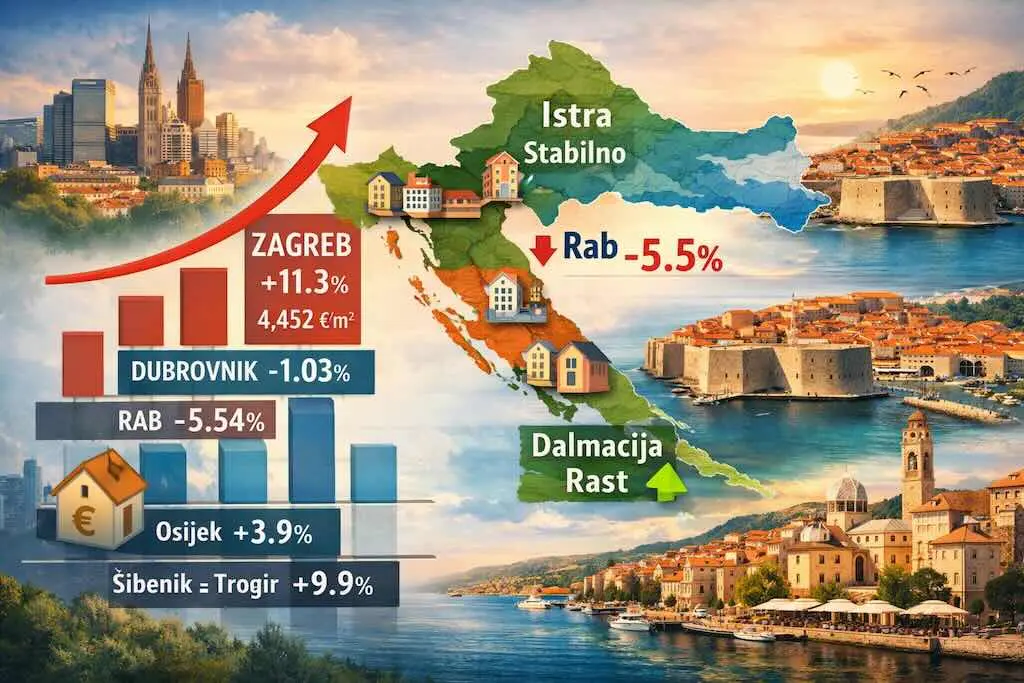
The most significant increase was recorded in Zagreb, where the average price of new-build apartments rose by as much as 11.31%, reaching EUR 4,452/m² (N=488). This surge confirms continued demand in the capital, which remains the leading market in terms of both growth dynamics and supply volume.
On the other hand, the luxury market in Dubrovnik recorded a slight decline of -1.03%, although prices remain at an exceptionally high level of over EUR 10,500/m² (N=10), making it still the most expensive market in the country.
In Istria, trends are generally stable. Cities such as Poreč (EUR 3,991/m², N=1032), Rovinj (EUR 5,195/m², N=198), and Medulin (EUR 4,011/m², N=375) show minimal changes, while Ližnjan stands out with a growth of 8.62% and a price of EUR 3,500/m² (N=79), indicating increasing demand in smaller yet attractive locations.
The Primorje-Gorski Kotar region presents a mixed picture. Opatija remains among the most expensive markets (EUR 7,220/m², N=342) with stable prices, while Rab recorded a notable decline of -5.54% to EUR 3,879/m² (N=58), which may indicate a correction after previous growth. Rijeka also recorded a slight decrease (-0.96%) with a price of EUR 4,162/m² (N=379).
In Dalmatia, positive trends stand out in Šibenik (+9.90%) with a price of EUR 3,900/m² (N=73) and Trogir (+4.36%) with EUR 4,411/m² (N=97), while Split recorded a decline of -1.32% to EUR 6,269/m² (N=55), which may signal short-term stabilization after years of growth.
Continental cities such as Osijek (+3.89%) with EUR 2,603/m² (N=34) and Varaždin (+0.46%) with EUR 3,064/m² (N=48) show moderate but stable growth, indicating a gradual expansion of demand beyond coastal and tourist zones.
The Croatian real estate market is entering a phase of differentiation. While major urban centers and certain micro-locations continue to record strong growth, most coastal destinations are showing signs of stabilization or slight correction. This suggests that investors are becoming increasingly selective, focusing on locations with long-term growth potential.
Tržište nekretnine, 29. Mar. 2026.
Latest news from category: Tržište nekretnine
- Where the Ultra-Wealthy Buy Their Second Home 09. Aug. 2025.
- Hong Kong Real Estate Market Desperately Seeks Chinese Investors 07. Aug. 2025.
- New Eurovilla Branch Opened in Osijek 14. Jul. 2025.
- Price trends for apartments in new construction in Croatia: 1.7.2024. - 1.7.2025 12. Jul. 2025.
- Broker Agency recommends the best regions for real estate investment in Croatia in 2025. 23. Feb. 2025.
- BiH: VAT Refund for First-Time Homebuyers 25. Oct. 2024.
- Apartment prices in Serbia are sky-high, is an additional increase realistic? 12. Oct. 2024.
- Croatia is at the top of Europe in terms of real estate price growth 10. Oct. 2024.
- Introduction of a new real estate tax in the Republic of Croatia 24. Sep. 2024.
Popular news
- Fabulous real estate prices in Bosnia and Herzegovina 31. Oct. 2023.
- The difference between a pre-sale contract and a contract for the sale of real estate 25. May. 2023.
- Prices of new apartments in Croatia 1/2024-2/2024 09. Feb. 2024.
- The sale of apartments in Novi Sad has stopped, but real estate prices are not falling 14. Jun. 2023.
- Apartment prices in Serbia are sky-high, is an additional increase realistic? 12. Oct. 2024.